
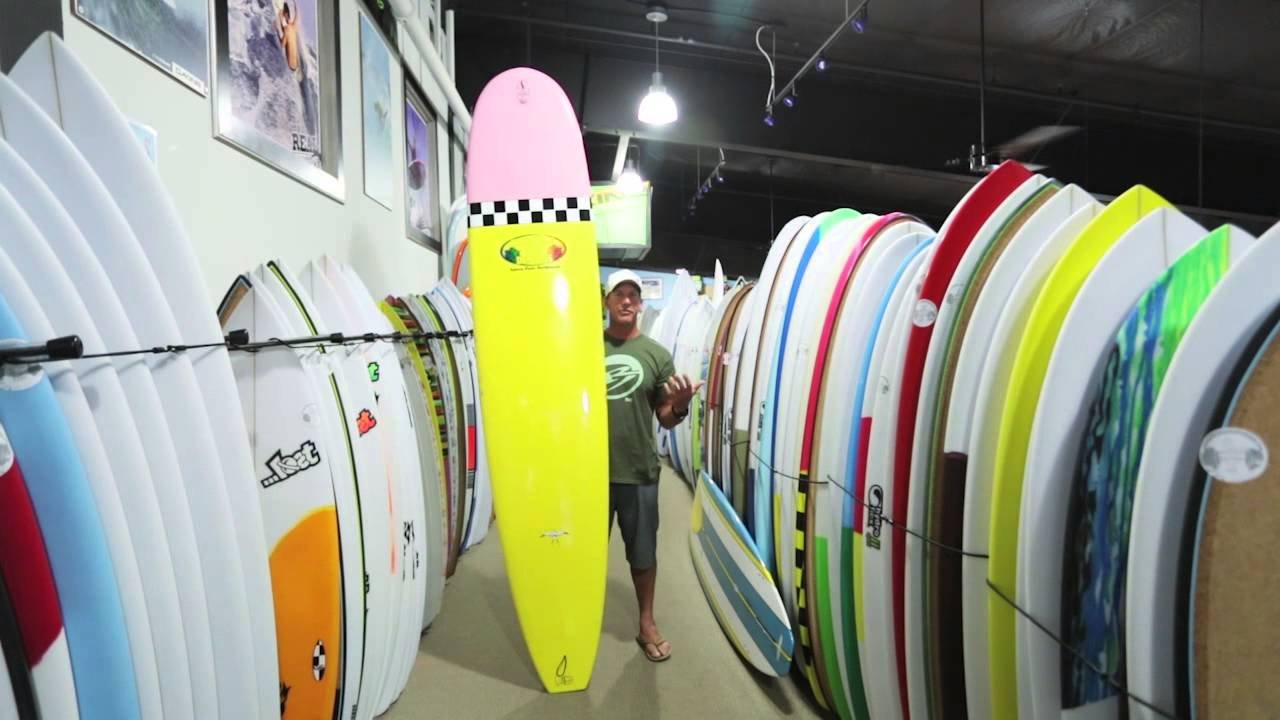
Choosing the right longboard depends on your ability and the breaks you surf. This guide breaks down longboard design into three major categories—Nose Riders, High-Performance, and Hybrids—and explains how rocker, fins, and construction affect performance.
Key Takeaways & Tips
1. Nose Rider Design
These boards are typically wider, have more foam, a rounded rail, and a single fin. They are designed to be ridden on small, peeling waves and stay in the pocket without having to turn. The rounded tail creates suction, sucking the board back up into the pocket.
Nose Rider Use
Best for surfers who live in places with soft, crumbly waves, or for anyone who wants to primarily focus on practicing cross-stepping and nose riding. They feel good gliding and trimming even in a straight line.
2. High-Performance Longboard (HPLB)
These boards are narrower, have a lot more rocker, and often use a 2+1, quad, or 4+1 fin setup. They are designed to be ridden aggressively, like a shortboard, allowing for powerful cutbacks and bottom turns. The increased rocker fits into curvier waves better.
HPLB Use
Best for intermediate/advanced surfers, or those surfing curvier, more powerful waves. They excel in better waves (thigh-high and above) and are great for maximizing wave count or on bigger days far outside the break.
3. Hybrid Designs
Hybrids combine aspects of both, often featuring wide noses (for noseriding) with performance rocker/edges (for turning). Popular hybrids (e.g., Takayama In The Pink, Robert August What I Ride) cover a wide range of use and ability due to their versatility.
PU/Poly Construction
Traditional Construction: Has a damp, neutral feel, excellent for absorbing vibration in bumpy surf. It has a nice aesthetic and is favored by longboard aficionados. Drawback: Not super durable; prone to dings if handled roughly.
Epoxy/Sandwich Construction
Modern/Low Maintenance: More durable and low-maintenance against dings and bumps, making it a better bet for rough handlers or sharing. Drawback: Boards are lighter and can feel a little more chattery in big, bumpy surf.
Common Mistakes to Avoid
Mismatched Rocker
Riding a flat-rocker nose rider in a very curvy, pitched wave. The flat board will not fit the curve, causing you to “stuff it” and fall over the nose or rails.
Ignoring Durability
Buying a fragile PU/Poly board if you are not spatially aware or are rough with your equipment. You will spend more time fixing it than surfing it, making a durable epoxy construction a better choice.
Judging by Length Only
Prior to knowing the different designs, assuming all longboards are the same and judging them only on length. There are huge differences in rocker, rail, and fin design that determine performance.