
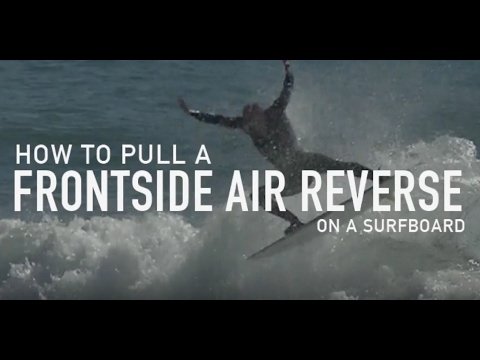
This tutorial breaks down the frontside air reverse, an advanced maneuver that requires excellent fundamentals and speed generation. The lesson covers the ideal setup (board and wind conditions), the jump technique for rotation, and the crucial steps for absorbing the landing shock.
Key Takeaways & Tips
Setup and Stance
The ideal setup requires a wide board (under the front foot) and a wide stance. You should adjust your stance to get your front foot up near the nose and your back foot right at the back of the tail pad. This makes the rotation easier and gives you more drive when leaving the lip.
Ideal Conditions
The best waves are medium height (waist to head high) with a powerful section leading into a smaller end section. The ideal wind is a light cross onshore wind, as this helps keep your board stuck to your feet when you are in the air.
Jump Technique
It is crucial to jump away from the wave as well as above it. You must throw your arms and body towards the beach for a strong rotation as you leave the lip. Perform a slight ollie, like on a skateboard, to throw your board into the rotation.
Tail High Air Reverse
A technique for an easier rotation is the tail high air reverse, where the tail throws up higher than the front foot. You pivot around your front foot, giving the illusion of a much higher air.
Landing
Just before landing, you should extend slightly to absorb the shock. Land on your front foot, compress, stay centered, and then let your fins touch the water. You must look back over your shoulder toward the beach as the board whips around.
Common Mistakes to Avoid
Angling Too Straight Up
Focusing only on jumping up above the wave is a mistake. You must angle away from the wave, or you risk landing off the back of the wave.
Hitting Section Too Early
Be careful not to race off and get to the section too early, as it may not be steep enough yet. You must hold back and let the lip develop.
Landing Rigid
Landing with straight legs risks injury to you and your board. You must extend slightly before impact so you can compress and absorb the shock.
Ignoring the Wind
Failing to consider the wind can cause the board to blow away from your feet when you are in the air.