
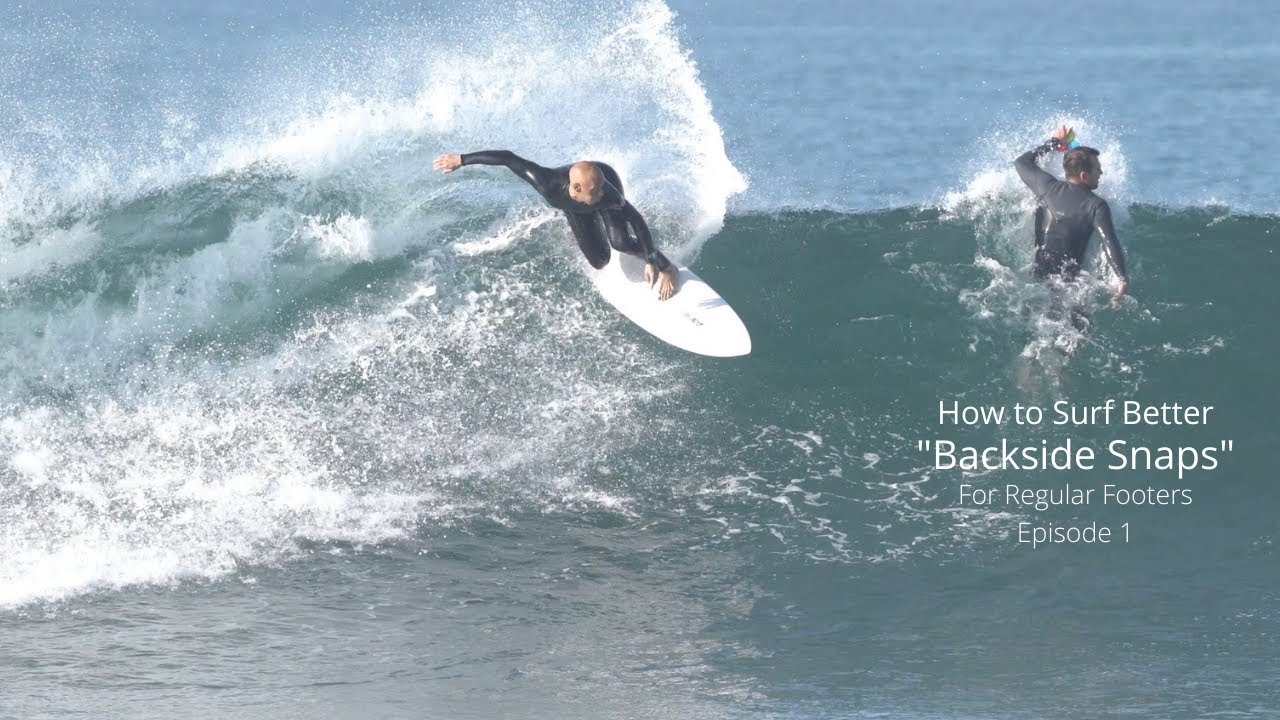
This tutorial, Episode 1 of the “How to Surf Better” Backside Snaps series, focuses on the **Speed Snap**—a maneuver used to generate and maximize speed on fast-running waves. The key mechanics involve creating a coil in the shallow bottom turn and releasing it explosively at the lip to project down the line.
Key Takeaways & Tips
Speed Snap Goal
A speed snap is always used to project and maximize speed to get down the line, either to reach open face or set up multiple maneuvers [8:27]. It is an appropriate starting point for surfers dealing with fast beach breaks [3:49].
Shallow Bottom Turn Entry
When surfing a fast wave, drop in quickly and do a shallow bottom turn (at about two-thirds of the wave bottom). The approach should be **diagonal** to the wave, not vertical, to maximize down-the-line speed and projection [8:08].
Coil and Uncoil
In the shallow bottom turn, compress and set the rail, causing the body to twist or coil. As you come up and hit the lip, the release of this coil (uncoil) is what creates the snap and spray [3:34].
Arm Position
On smaller waves, both arms should be in front of the body to maximize speed and projection. On bigger, faster waves, the **trailing arm** can be held back for better balance, while still driving the back knee into the front knee [7:15].
Weight Distribution
Weight distribution for the shallow bottom turn is approximately 60% on the back foot and 40% on the front. During the speed snap and projection, the weight shifts forward to about 40% on the back foot and 60% on the front foot to accelerate down the line [7:56].
Common Mistakes to Avoid
Pivoting at the Bottom
Attempting to wipe speed off by doing an abrupt turn (or wipeout) at the bottom will not set up the rest of the wave properly. A solid bottom turn is key to setting up your turns in the pocket [1:44].
Losing the Coil
The snap you get at the top is directly equivalent to the amount of coil loaded in your shoulders and hips on the bottom turn. If you fail to coil, the snap will be weak [6:04].
Looking Down the Line in a Hollow Wave
If the wave is hollow, focusing only down the line (horizontally) instead of more diagonally down the face can cause you to “purl” or go over the handlebars due to the wave’s vertical push [8:08].