
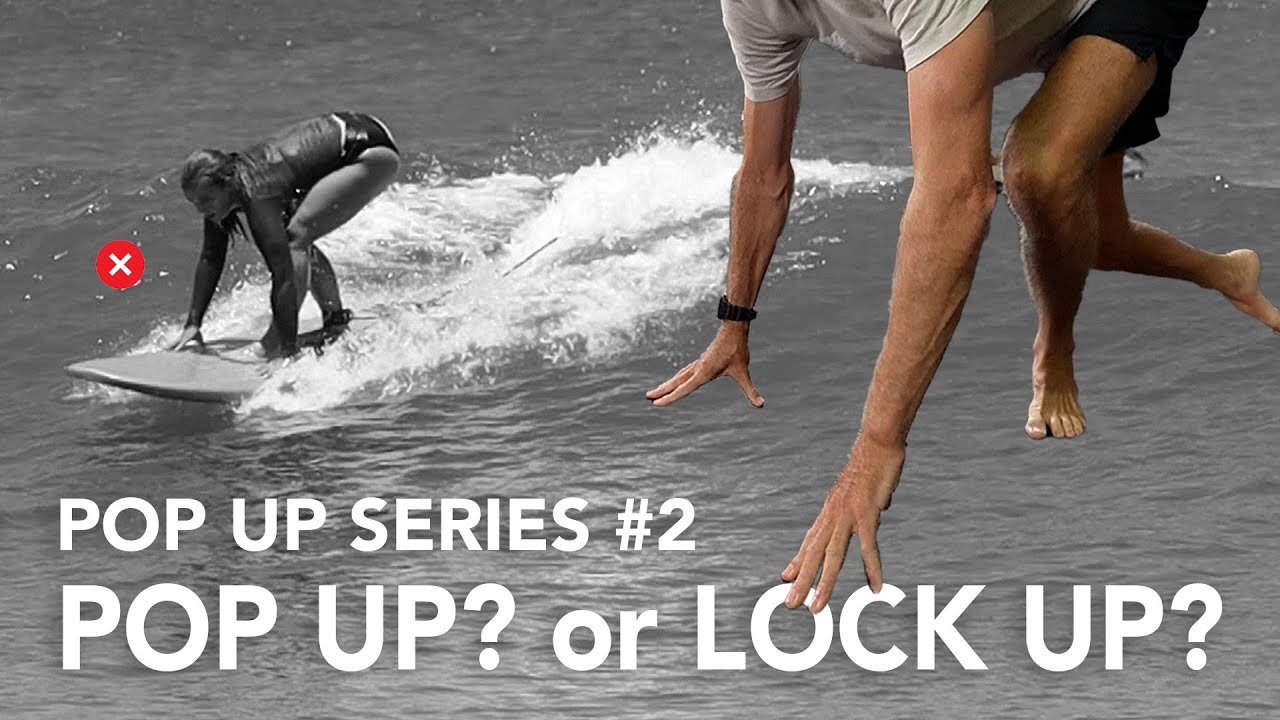
This tutorial argues that the commonly taught “perfect pop-up” is actually a “lock-up” that creates numerous problems, locking the feet and body in the wrong place and preventing necessary adjustments. It breaks down the proper technique, referred to as the “walk-up” or “run-up,” using 11-time World Champion Kelly Slater as the ideal example.
Key Takeaways & Tips
The Pop-Up Problem
The traditional pop-up is a lock-up: it stops you from moving, prevents you from compressing/extending/turning, and locks your head and feet in the wrong place, creating a bend in your back that hinders progression.
The Walk-Up Technique
The walk-up is the solution, as it is a stable way of getting up. It relies on maintaining **three points of contact** with the board at all times during the transition, from shortboard to longboard [9:19].
Head and Shoulder Stacking
The head, shoulder, knee, and ankle should all be stacked over the **front foot**. This places the surfer’s weight over the widest, most stable part of the board and helps push the rocker down for acceleration [12:44].
Front-On Stance
Avoid the side-on stance, which causes the head to hang over the side and encourages rail-digging. You should transition into a more **front-on position** to gain 180 degrees of peripheral vision and enable proper body rotation [7:07].
Line of Travel
Surfing is a circle of energy (a spiral). You should never surf in straight lines, as the board is not designed for it. Instead, surf in **figure eights or S-curves** (semicircles) to maintain flow and avoid catching rails [18:10].
Common Mistakes to Avoid
Worrying About Perfection
Trying to nail a “perfect pop-up” is virtually impossible. You want to be in a position where you can **make adjustments**, as surfing is constant, incremental adjustment, not a locked-in stance [3:20].
Looking at the Board
Do not look at the board while popping up. You should be paying attention to the wave (line, speed, section) so you can make intuitive decisions, which will in turn fix your pop-up [5:09].
Disconnecting the Body
The pop-up often causes a disconnect, preventing movement from traveling sequentially up through the ankle, knee, hip, and shoulder. This makes the board unresponsive when you try to use your arms to turn.
Standing on the Back Foot
Standing on the back foot is common due to fear and board design, but it is unstable, forces you to use the fins to control everything, and requires you to work against the wave’s energy [13:23].