
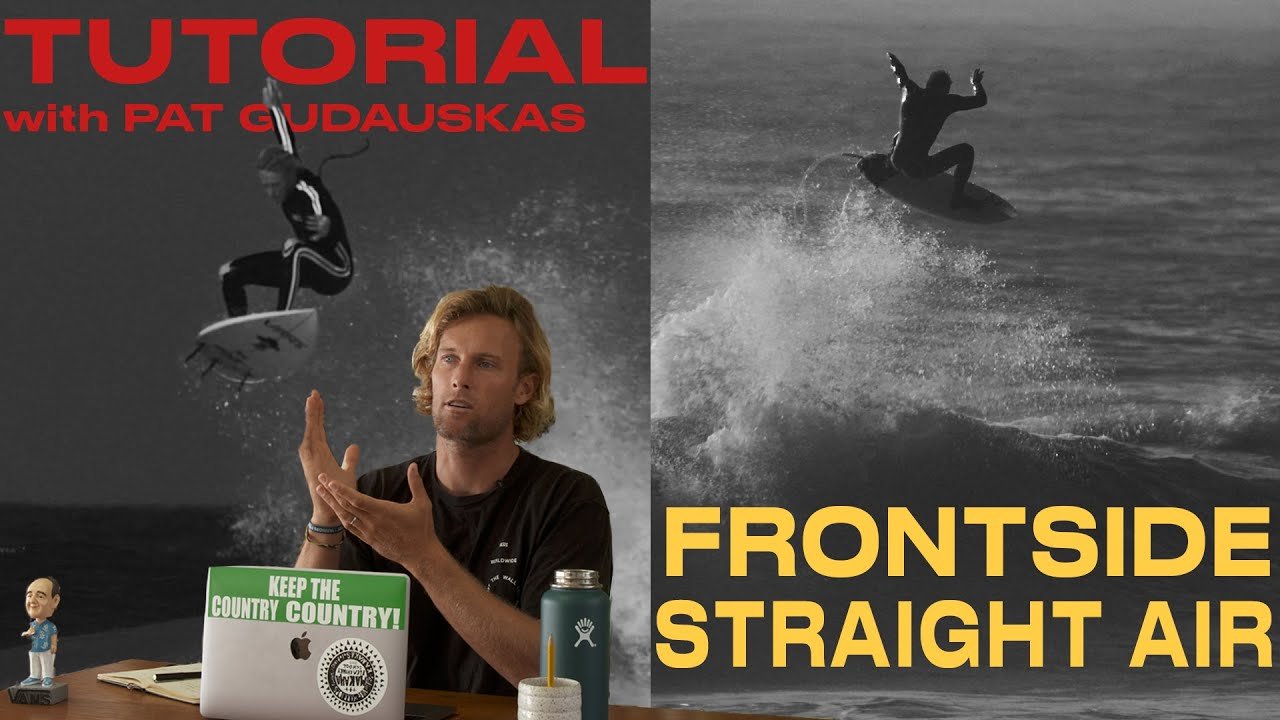
Pro surfer Pat Gudauskas breaks down the frontside straight air, emphasizing that going fast is everything for this maneuver. The tutorial details the vertical angle of attack, the ollie-like jumping technique, and the crucial shock-absorbent landing.
Key Takeaways & Tips
Speed and Verticality
Generating speed is everything for this maneuver. The section you hit must be vertical (like a skate ramp) to create the ollie transition into the air. Hitting the section at a more vertical angle gives you more height and amplitude in the air.
Approach and Timing
When approaching, you must focus on timing the section. You should hold your line, and at the right moment (when the wave is curved, not breaking, not flat), you explode and hit it with everything you have.
The Olliee Jump
The maneuver is like a skateboard ollie. As you jump, suck your front knee up high. This allows the board to go vertical and flat, giving you big, flat amplitude in the air. The explosive energy goes into the air through the jump.
Landing Technique
The landing is about absorbing the shock. You do not want to be rigid or stiff. The legs should be extended enough to absorb the shock into a condensed body position, giving you a shock-absorbent transition that allows you to ride out smooth and saves your knees.
Bottom Turn Angle
If you bottom turn too low into the trough, you will lose speed by the time you reach the section. The turn should start mid-face so you can attack the section with full speed.
Common Mistakes to Avoid
Going Straight Up
If you hit the section at too much of a lateral angle, you will travel too much distance. If you go too vertical, you will go higher, but it’s often more difficult to land.
Landing Rigid
Landing with rigid or straight legs will risk injury to you and your board. You must land in a compressed position.
Overlooking Speed
Failing to go as fast as you can is the biggest mistake. Speed is everything for amplitude, unless the wave is extremely wedgy or powerful.