
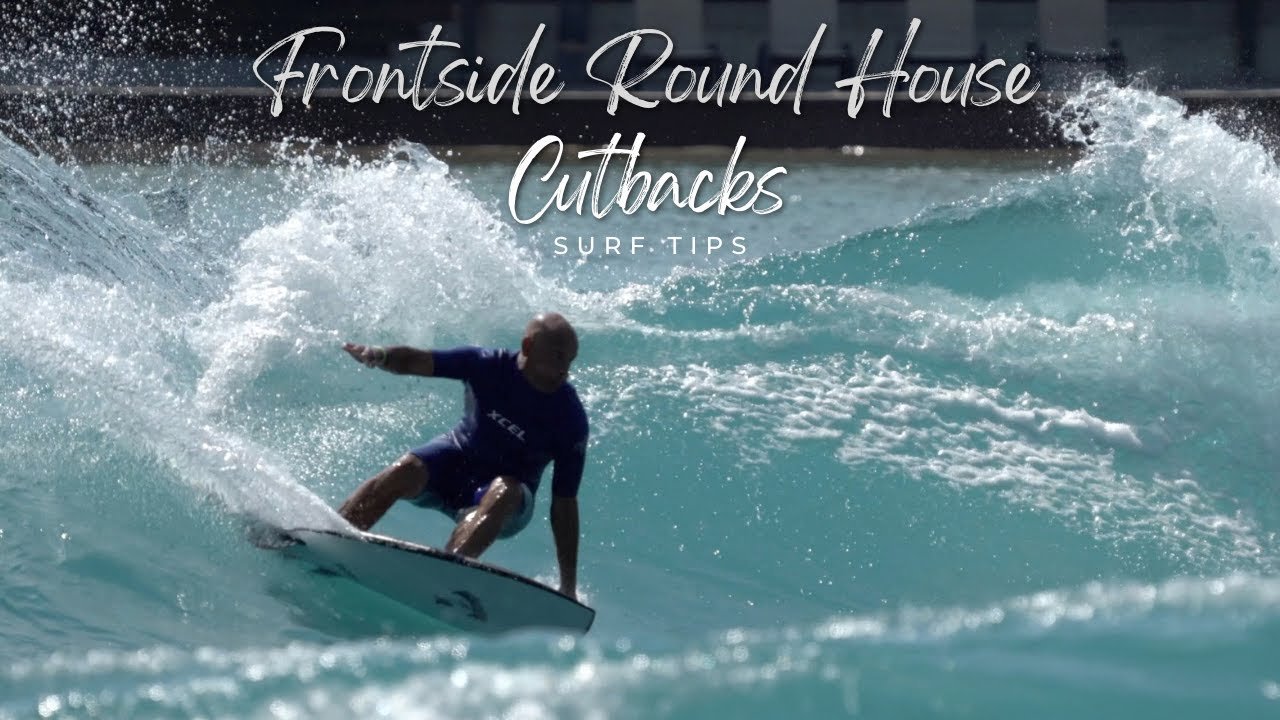
This technical surf tip breaks down the frontside roundhouse cutback, focusing on the advanced concepts of weight distribution and heel-toe pressure to maximize rail engagement, drive, and the verticality of the rebound. The tutorial heavily utilizes surf-skate training to translate technique from land to water.
Key Technique Breakdown
Commit Head First
Start the cutback by looking back at the power source (the white water). Committing with your head first opens your shoulders and hips, enabling the rotation needed to hit the transition and execute the rebound.
Weight Distribution for Initiation
Initiate the cutback with your weight shifted roughly 70% to the back leg and 30% to the front leg.
Heel-Side Rail Engagement
To engage the rail for the long arc of the cutback, apply 70% of your weight down through your heels. Maintain this pressure and hold the heel-side rail throughout the entire turn.
Weight Shift for Pivot
As you move through the turn and get closer to the power source, shift your weight forward to about 70% on the front leg while still keeping the heel-side rail engaged.
Toe-Side Pressure for Rebound
To snap and pivot back, the weight shifts back to the tail, and you must rapidly apply 70% of your weight to your toes. This “snaps” the board onto the toe-side rail, enabling the vertical rebound.
Cutback Starting Point
Starting the cutback lower and further out on the wave face allows you to come from the trough back up to the lip. This wider arc gives you more vertical potential on the return/rebound compared to staying higher on the wave face.
Surf-Skate Training & Equipment
Drill for Drive
Use a surf skate to practice attacking the curbs and perfecting the rail-to-rail technique, focusing on maximizing drive through the entire arc.
Wheel Comparison
The difference in wheel width and rubber on the surf skate significantly changes the performance:
- Wider Wheels (More Traction): Offer more hold and speed with less effort, resulting in a smoother, more round turn.
- Narrower Wheels (Less Traction): Offer a looser, more high-performance feel, resulting in a quicker pivot and more progressive, vertical turn.