
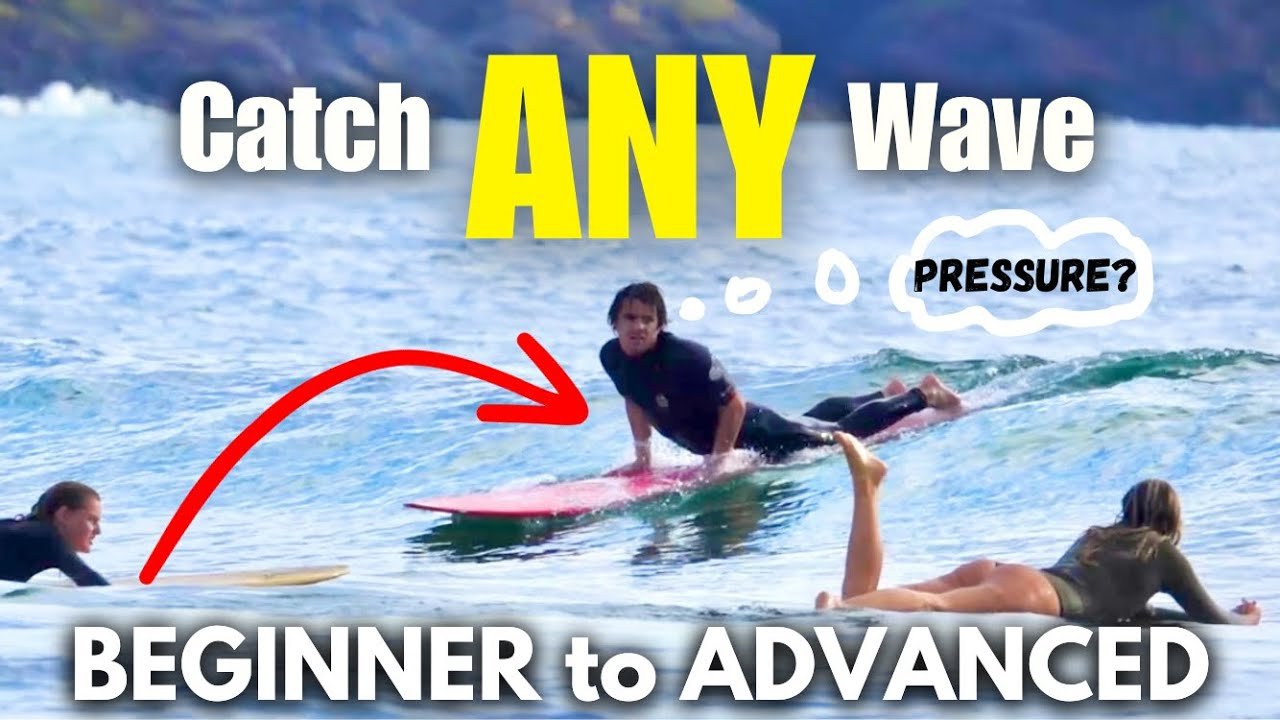
This full guide breaks down paddling into beginner fundamentals and advanced adaptation techniques. It emphasizes that efficient paddling is crucial for getting onto the waves you want, positioning yourself correctly, and having the necessary energy to surf bigger, faster, and harder waves.
Key Takeaways & Tips
Beginner Tip 1: Board Position
Your position on the board should replicate the board lying flat on the water. Avoid being too far back (creating drag) or too far forward (leading to nose diving). Your chest is usually a little forward of the midpoint.
Beginner Tip 2: Body Position
Keep your chest up and legs together. Keeping your feet together stops the legs from dangling and creating drag in the water.
Beginner Tip 3: Paddle Technique
Use long, deep strokes. Fewer, longer strokes are much better than many fast, shallow strokes. Also, paddle three more times than you think you need to, to avoid missing the wave and popping up too early.
Advanced Tip 1: Commitment Paddle
Do not stop paddling as the wave starts to lift you. This is the key moment where you must double down and go in for those few hard extra paddles. This will accelerate you with the wave and match its angle.
Advanced Tip 2: Matching the Angle
You should aim to match the angle of the wave with your board, essentially mirroring the wave’s curve. Commit your paddle in from the bottom of the wave, and as you lift up, accelerate by pressing your chest into the board.
Advanced Tip 3: Adjusting for Steeper Waves
For steeper waves, you won’t need lots of paddles. Wait and position yourself further out to catch the wave before it breaks. You only need two to three good paddles in the crucial lifting period before assuming the Cobra position.
Common Mistakes to Avoid
Paddling Break
The common mistake is the start-stop paddle (paddle-break-paddle). Stopping your paddle brings weight to the back of the board, lifting the nose and preventing you from matching the wave’s angle.
Too Shallow Strokes
Using many fast, shallow strokes is ineffective. Focussing on fewer, long, deep strokes is better for efficiency.
Arching Back
As the wave lifts you, do not arch your chest back and stop paddling. This is the critical moment you must be paddling hardest, or you risk being thrown over the falls.
Rushing Takeoff
Paddling too hard too soon in excitement is a major error. It causes you to run into the wave when it’s too steep and breaking, leading to a fall.